

Find the tool for your IECMHC needs
Our library holds 250+ free resources on IECMHC research and practice. Browse them below, or send us a tool, presentation, event, or paper to add.
Browse the library
Everything is free, and you don't need an account.
HandoutA Quick Guide for Child Care Providers on Understanding Childhood TraumaIn partnership with Illuminate Colorado and the University of California, San Francisco’s Child Trauma Research Program, the Thrive Center developed a set of handouts tailored for early care and education (ECE) settings. These handouts, available in English and Spanish, explore substance use and childhood trauma, and how ECE professionals can support the children and families they serve who are affected by these challenges. IECMH Consultants can share these short, colorful resources with their consultees to address these sensitive topics in an accessible, compassionate way. This specific handout focuses on helping child care providers understand childhood trauma.Spanish GuideA Roadmap for Collaborative and Effective Evaluation in Tribal CommunitiesInformation on community-based participatory research specific to evaluations in tribal communities. Webinars and eventsAddressing equity across the early childhood systemAddressing equity across the early childhood system: How Infant and Early Childhood Mental Health Consultation is being implemented across a variety of early childhood settings. This panel session will feature leaders working across a variety of early childhood system settings including home visiting, early intervention, child welfare and primary care. They will describe how they have been able to work within these systems, foster collaboration and the challenges of providing consultation outside of the traditional early care and education settings. Addressing equity includes ensuring that services such as consultation are available to children, families and providers in all the settings in which families receive supports and services and panelists will engage in the challenges of doing this as well. Webinars and eventsAdvancing Anti bias Practices in IECMHC Through Reflective SupervisionIn this presentation participants will engage in an in-depth conversation about the ways that IECHMC can be a disrupter of bias, specifically through reflective supervision. First, participants will be provided with an understanding and definition of anti-bias consultation, followed by a brief overview of the Reflective Supervision for the Whole Job and the Whole Organization framework developed by the Reflective Supervision Collaborative (RSC). The framework is a whole-person, long-term learning approach informed by equity, diversity, and inclusion. Next, we will share voices from the field (consultants) on how reflective supervision helps deepen self-awareness of one’s bias and assumptions, with an emphasis on the core processes within the RSC framework. We will also share a few practical strategies that supervisors can use in their role as a disrupters of bias and how their role influence the parallel process between consultant and consultee. Lastly, participants will hear from an IECMHC provider’s efforts around commitment to and action towards disrupting bias. In addition to the above content, participants will watch a mock supervisor session on how consultants can have a conversation with teachers’ of color use of unsupportive emotional responses with Black boys. Webinars and eventsAdvancing Equity in Early Care for Families of Infants and Toddlers with Complex NeedsThe COVID-19 pandemic has had a profound impact on children and families and has deepened disparities and inequities. Some families with young children have been left behind, cut off from essential developmental, educational, and health services. This session will highlight cross sector partnerships between IECMHC and community providers seeking to re-engage families with infants and toddlers with complex needs. Join us for stories about how the IECMHC role is helping guide new efforts to improve equity in early care in Ohio. GuideAdvancing the Evidence Base for IECMHC: Guidance for Evaluators and Program PartnersThis guide illustrates the different purposes for which data may be gathered and analyzed in the context of IECMHC, organized by the goals of the program. It is intended to help programs design and implement an approach to evaluation that is intentional, realistic, and driven by their priorities. Webinars and eventsAffirmed, Valued, Esteemed: AVEnue to Equity in ECE WorkforceThe well-being, equitable support, and retention of Early Childhood educators is in urgent need of intentionally focused attention, especially for educators who identify as Black, Brown, Indigenous, People of Color (BIPOC). Coming out of a global pandemic, many of these educators face unprecedented complexity in everyday life, both at work and at home. BIPOC educators are adversely impacted by numerous intersectionalities that can lead to confining states of personal and emotional distress. “Pervasive structural inequities across the early care and education workforce have been deepened by the pandemic, with Black, Hispanic, and Native American populations experiencing higher rates of COVID-19 infection, hospitalization, and morbidity (Mude et al., 2021). Job stress, burnout, and depressive symptoms are commonly reported by early educators and are associated with both diminished quality of learning environments and high job turnover.” (Johnson et al., 2020). The presenters strongly believe that providing personal development support such as Life Coaching, will positively impact outcomes not only for the educators, but for their students as well. Emotionally healthy educators who feel affirmed, valued, and esteemed, are capable of supporting the emotional/social development of young learners. They are also more likely to grow in their teaching practice as they experience greater job satisfaction and increased teacher effectiveness. This session will highlight overlooked issues and concerns that adversely impact many BIPOC early educators' mental and emotional well-being, and overall teaching performance. We will also explore the benefits of building an effective ECE workforce through system-wide changes that offer individualized personal and professional development, such as life coaching. TemplateAgreement of PartnershipSample contract between SEP-CAP Head Start and partnering agency for mental health service provision. ReportAn Interdisciplinary Evaluation Report of Michigan’s Childcare Expulsion Prevention (CCEP) InitiativeMichigan State University evaluated Michigan's Childcare Expulsion Prevention program from 2007 to 2010. Parents saw their children improve more than a comparison group on hyperactivity, attention, and social skills, and reported less parenting stress. ReportAnnotated Bibliography: The Evidence Base for Infant and Early Childhood Mental Health Consultation (IECMHC)Our Annotated Bibliography summarizes the contributions of every known published study of IECMHC, across settings and outcomes of interest. It builds general knowledge about IECMHC, supports writing about IECMHC, and points to future directions for research. Webinars and eventsApplying a systems lens to decolonize IECMHC from the ‘inside out’Our hope for this session is to offer participants an opportunity to reflect on how we might move together (and sometimes separately) to transform our work in IECMHC by applying and embodying a strong anti-racist lens. Much of our work at Indigo Cultural Center is informed by the IECMHC workforce who identify as Black, Indigenous or as persons of color (BIPOC). Accepting and remaining open to recommendations that flow from BIPOC voices represents a major departure from the way most of our IECMH field has been shaped over the past 70 years. The racial dynamics that are particularly unique to our current charge of transformation can bring up concerns of safety and comfort for many. However, we also know through the tenets and canon of the IECMH field that discomfort is necessary for growth. Indeed, Resmaa Menakem reminds us that “We learn and grow up by experiencing discomfort, accepting it, moving through it, and coming out the other side. In the process, we metabolize the discomfort, and, paradoxically, it disappears. When we don't allow ourselves discomfort, we don't permit emergence or growth” (Menakem, 2017). In summary, our objectives for this session are to review social justice language and frameworks that guide much of our work and to provide tangible examples of how the healing justice movement is being applied (and can be applied) to our work in IECMHC. This workshop, including the frameworks, examples, and recommendations we share, is offered in a spirit of growth and a co-envisioned future where we can all experience liberation and healing. Webinars and eventsApplying the FAN Model to Integrate Infant & Early Childhood Mental Health ConsultationIn 2020, the Sacramento County Office of Education partnered with the Sacramento County Department of Health Services to place a mental health clinician in each of our 385 public schools in our County. The Early Childhood Education department envisioned this would be an excellent opportunity to expand ECMH Consultation services in the county, as California was beginning to expand Transitional Kindergarten throughout the state, bringing an increasing number of 4-year-olds onto public school sites. Attempting to integrate Early Childhood Mental Health Consultation services into a large, expanding school-based mental health and wellness grant has presented many challenges, setbacks and successes that the speaker will share. Among them, she will discuss the process of adapting Dr. Linda Gilkerson's ‘Facilitating Attuned iNteractions’ (FAN) Model as a framework for partnering with complex systems to support reflection, listening to others, collaborative exploration and beginning steps towards capacity building of mental health clinicians in an educational setting. The presenter will share outcomes of her initial professional development workshop and exciting opportunities to expand ECMH consultation through Sacramento County in the coming years to address early childhood inequities and bias toward boys of color. Participants will be given the opportunity to reflect on how core principles and practices of IECMHC may be integrated into their work with complex systems. Target Audience: IECMH Consultants who work with complex systems.
Core topics
For those who are ready to dig deeper than the IECMHC Basics, resources are clustered into the following five topic areas, which align with the core components of strong IECMHC programs and overall high-quality consultation services.
- Programs and ModelsThe nuts and bolts of IECMHC service delivery and IECMHC program infrastructure: what you provide, to whom, where, and how, and how to pull it all together.
- WorkforceThe competencies, training, supervision, mentoring, and quality assurance systems needed to build a strong IECMHC workforce.
- EquityStrategies and information to help IECMHC programs and consultants reduce disparities and promote effective, nurturing caregiving for all children.
- Research and EvaluationThe research base for IECMHC and guidance on developing and effectively utilizing theories of change, logic models, evaluation plans, and other research tools to measure IECMHC program fidelity and impact.
- Policy and FinancingTools and knowledge to support financing and sustaining IECMHC efforts, including key policies/initiatives, creative funding streams, and tips for strategic communication.
What the research shows in each setting
Consultation works in more than classrooms. See what the research shows in each place young children are served.
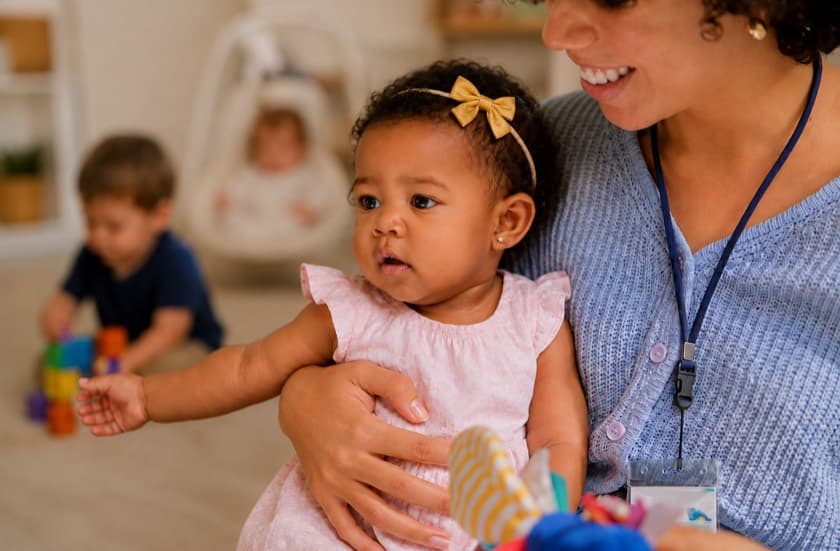
Early Care and Education
See the evidence
Home Visiting
See the evidence
Early Intervention
See the evidence
Child Welfare
See the evidence
Pediatric Primary Care
See the evidence
The full curriculum
We offer ten free, self-paced courses that run from defining the work to evaluating it. Anyone can take them, and you don't need an account.
- Strengthening Early Childhood ProgramsThis tutorial explains why mental health belongs in early childhood settings. It also shows what consultation changes in Head Start.
- Defining Early Childhood Mental Health ConsultationThis tutorial explains what consultation is and what it isn't. It also covers the consultant's role.
- The Effective Mental Health ConsultantThis tutorial covers who does this work and the competencies it takes. It also shows how to deliver high-quality services.
- Mastering the Consultative StanceThe consultative stance is what this work rests on. This tutorial shows how a consultant holds it in practice.
- Partnering with FamiliesThis tutorial treats family engagement as part of consultation practice. It covers how to set the stage for partnerships with families and how to strengthen them.
- Recognizing and Supporting Social Emotional DevelopmentThis tutorial covers social and emotional development from the first year through age five. It also covers risk factors and community referrals.
- Recognizing and Addressing TraumaThis tutorial explains trauma and how it affects young children. It covers the signs to watch for and the consultant's role.
- Developing a Vision and Strategic PlanThis tutorial shows how to turn a mental health vision into a program-level strategic plan and put it into practice.
- Implementing and Evaluating ECMHCThis tutorial covers job descriptions, hiring, contracts, workgroups, and continuous quality improvement.
- Cultural and Linguistic CompetenceThis tutorial looks at the cultural context of consultation and how to practice in a culturally responsive way.
Guides
Each guide gathers everything we've published on one subject into a single page you can read start to finish.
- Classroom ideas that hold big feelingsTeachers can use these classroom ideas right away. They cover emotions, friendship, problem solving, and handling disappointment.
- The IMH specialist suiteWhat infant mental health work is, what an IMH specialist does, and where to find specialized training.
- Five actions on maternal depressionFive actions for programs: identify families, train staff, use reflective supervision, connect families to care, and reduce stigma. Take them in order. The sequence is the intervention.
Help us expand the evidence base
We're growing our resources and research, and we want to work with researchers.
Key topics of focus:
- The impact of IECMHC in Home Visiting, EI, and Child Welfare
- The ROI of IECMHC and impact on staff turnover, expulsion and suspension rates
- The effectiveness of IECMHC consultants from non-clinical backgrounds
Become a Center of Excellence and Attunify certified consultant
Train with the team that wrote the national IECMHC competencies.