
IECMHC in Home Visiting
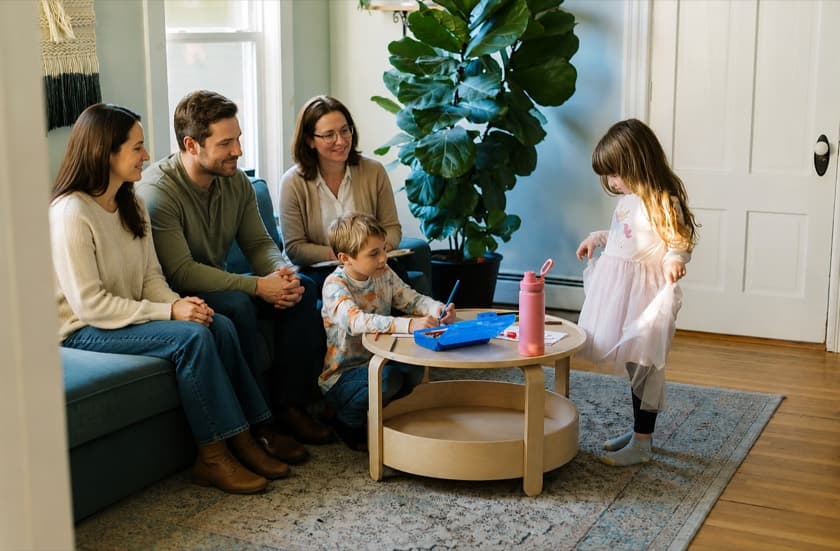
Home visitors often carry the earliest relationships in the system alone. Consultation gives them a partner who helps them understand what a family is going through and how to respond.
Watch the home visiting open house
Recorded 53 min
Trista Vonada, Tiffany Ajayi and Shai Idelson show how home visiting programs bring in consultation without a funded consultant position.
See the event pageWatch the Parents as Teachers session
Recorded 17 min
Shai Idelson and Neal Horen walk Parents as Teachers through what consultation is, the evidence, and how to get access.
Read the write-up
What consultation is in home visiting
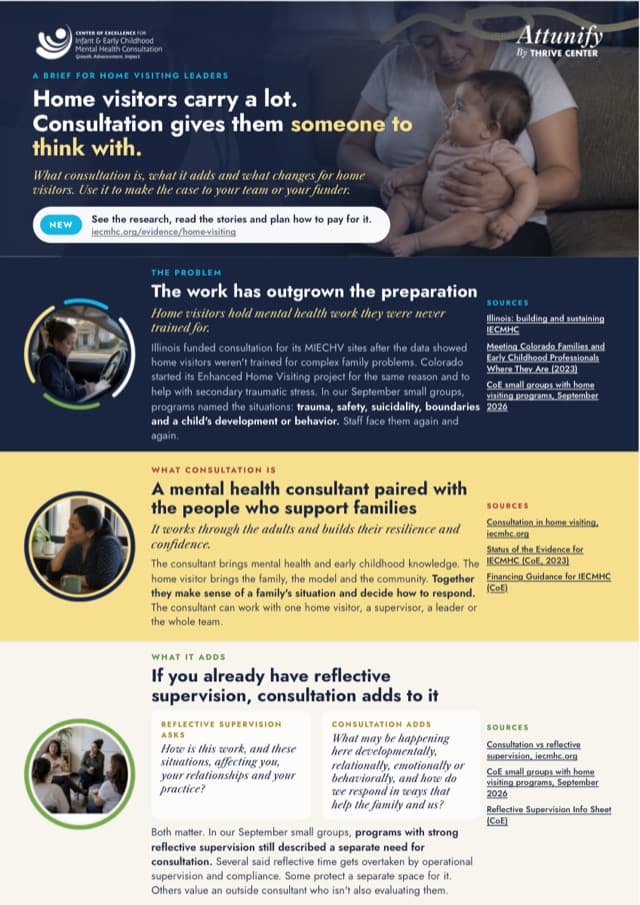
In home visiting, consultation pairs a mental health consultant with the people who support families: home visitors, their supervisors, program leaders or a whole team. It isn't therapy. It works through those adults so they can support a family's relationships and a child's social and emotional development. It also builds the adults' own resilience and confidence.
Who the consultant works with
Consultants work with home visitors, their supervisors, program leaders or a whole team. The work happens in case consultation, reflective sessions and training.
What changes
Home visitors ask what may be happening in a family developmentally, relationally, emotionally or behaviorally. Then they ask how to respond, and they become more responsive to families.
Where it fits
Consultation fits alongside the model you already run. Colorado's evaluation covered five home visiting models: Parents as Teachers, Nurse-Family Partnership, HIPPY, SafeCare and Healthy Steps. A 24-month pilot(opens in a new tab) ran inside a Healthy Families America program.
Practical Certificate in IECMHC
Train staff you already have to help home visitors respond to what families are going through.
IECMHC works at three levels in home visiting
- Read Story 4: Case consultation(opens in a new tab)
Child and family
A home visitor brings one family to case consultation. The consultant's questions help the visitor understand the parent's behavior in light of the parent's own history. With the family's consent, the consultant may also join a home visit.
- Read Story 5: Group consultation(opens in a new tab)
Home visitor and team
The consultant joins supervisors and home visitors in reflective supervision. In group consultation, the team reflects on a family together. The consultant also builds training around what home visitors need to know.
- Read Story 2: Connecting with the supervisor(opens in a new tab)
Supervisor and program
A new consultant meets each supervisor and learns how the program runs. Supervisors get their own reflective consultation and clear agreements about what that time is for.

What's the difference between consultation and reflective supervision?
Reflective supervision is contained within the practice of consultation, and both are critical to the work of a home visitor.
Reflective supervision asks
How is this work, and these situations, affecting you, your relationships and your practice?
Consultation adds
What may be happening here developmentally, relationally, emotionally or behaviorally? How can we respond in ways that help the relationship, the child and their family, and us?
Make the case for consultation at your program with our two policy briefs
What the evidence says about IECMHC's impact in home visiting
- 21 months
- of consultation grew reflective capacity for Illinois home visitors and educatorsSource for 21 months, of consultation grew reflective capacity for Illinois home visitors and educators
- 3.63 to 3.86
- home visitors' self-efficacy on a 5-point scale after working with a consultant in MichiganSource for 3.63 to 3.86, home visitors' self-efficacy on a 5-point scale after working with a consultant in Michigan
- 92% vs 40%
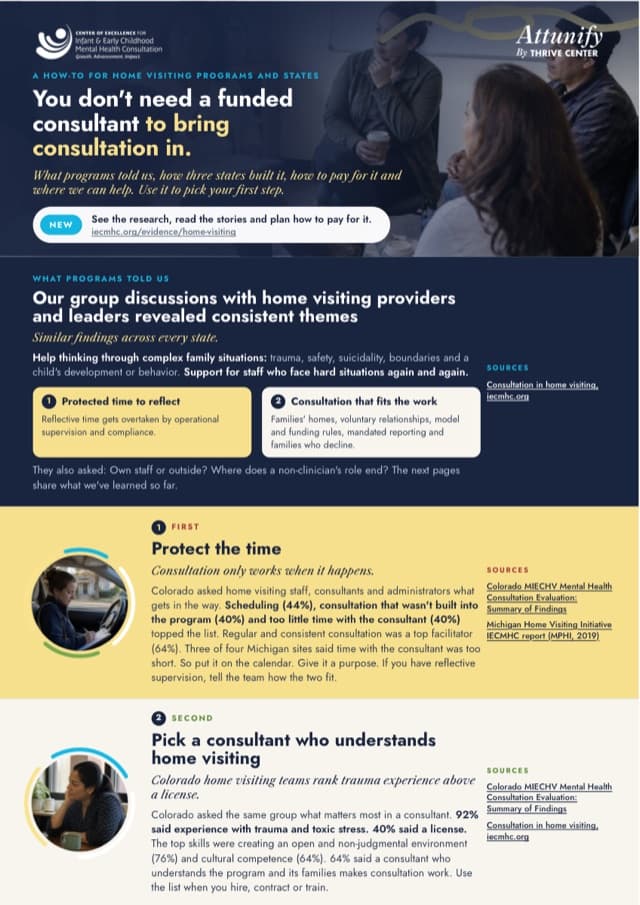
- of Colorado respondents valued trauma experience in a consultant vs a professional licenseSource for 92% vs 40%, of Colorado respondents valued trauma experience in a consultant vs a professional license
Home visitors become more responsive to families, and reflective capacity grows
In an Illinois pilot, researchers scored recordings of real home visits. Home visitors receiving consultation rated significantly higher on responsiveness to the family over time than a matched comparison group. The pilot also followed 136 staff for 21 months. Staff receiving consultation, including home visitors, significantly increased their reflective capacity.
Self-efficacy rises and job stress falls
Michigan's Home Visiting Initiative measured home visitors at 4 sites before and after they worked with a consultant. Their self-efficacy rose from 3.63 to 3.86 on a 5-point scale. The gain was statistically significant. Job demands fell and job resources rose.
Michigan Public Health Institute, 2019
Knowledge and confidence improve
In a 24-month Healthy Families America pilot, home visitors gained knowledge of mental health and confidence partnering with parents.
Early family exits fell from 29% to 14% in a Colorado project with no comparison group
Every site was required to hold group reflective consultation with a mental health consultant. The 14% comes from the year COVID-19 began, and sites reported the numbers themselves. The evaluation says it can't prove the project caused the change.
Parent Possible, 2017-2020 evaluation
Home visiting staff reported more mindfulness and mixed results on stress
Parent Possible's yearly reports cover staff who were offered reflective consultation, training and mindfulness support. In 2023, 82% reported higher mindfulness. Burnout rose slightly in 2021 and 2022, and the reports point to the COVID-19 pandemic. Staff rated themselves, with no comparison group.
Parent Possible, 2021 to 2023 progress reports
Read the full evidence
There’s more than one way to pay for IECMHC
We don’t know of a state that pays for consultation from a single dedicated source. In our national scan, most states braid 2 to 4 time-limited funding streams. Answer 4 quick questions to see the ones that fit your program.
1 of 4: Focus
Who will consultation mostly focus on?
Practical Certificate in IECMHC
Bring consultation into your home visiting program
The Practical Certificate trains home visitors and the staff who support them on the national IECMHC competencies. They train virtually for four months, then get eight months of reflective supervision.
See the Practical Certificate18%
of our June cohort work in home visiting
Self-reported data from our June cohort
See IECMHC in practice
- Colorado MIECHV Evaluation (opens in a new tab)How consultation runs in Colorado's MIECHV programs and what helps or gets in the way.
- Embedding IECMHC in MIECHV Programs (opens in a new tab)Federal guidance and a getting-started checklist for MIECHV awardees and local agencies.
- IECMHC and the Pyramid ModelHow consultation and the Pyramid Model fit together and what the consultant does in home visiting.
- Five actions on maternal depressionWhat programs can do: identify families, train staff, use reflective supervision, connect families to care and reduce stigma.
- Reflective Supervision Info Sheet (opens in a new tab)A guide to reflective supervision for supervisors.
Bring it to your home visiting program
You don't need a funded position to bring consultation into your program.
Three ways in
- Train your own staff: build consultation capacity inside your program with the Practical Certificate.See the Practical Certificate
- Get consultation now: Georgetown consultants work with your staff virtually, starting within days.See Virtual Consultation
- Design your system: we help you plan and build a system of consultation support.See Technical Assistance