

Find the tool for your IECMHC needs
Our library holds 250+ free resources on IECMHC research and practice. Browse them below, or send us a tool, presentation, event, or paper to add.
Browse the library
Everything is free, and you don't need an account.
Webinars and events2022 CoE Conference: Culture, Diversity and Positive Representation in Early Child Care Settings Webinars and events2022 CoE Conference: Holding Hope: How Washington Partners IECMHC with Coaching to Support Child Care ProvidersHolding Hope: IECMHC through Child Care Aware of Washington is a newly launched IECMHC service that intentionally partners MHCs with Early Achievers Coaches to support licensed child care providers in Washington. In addition to providing child/family, classroom, and programmatic IECMHC for child care providers, we also consult and partner with Coaches in an effort to build Coach capacity to prevent and respond to social/emotional and behavioral concerns and risk for expulsion in child care settings. The session shares stories and early lessons from the program's first year, for program leaders, MHCs, and anyone interested in MHC and Coach partnerships. Webinars and events2022 CoE Conference: Infant Mental Health Endorsement in Virginia Webinars and events2022 CoE Conference: Leveraging Reflective Opportunities: Building Organizational Capacity for IECMH ConsultationJoin us for a discussion about how reflective moments can deepen and expand the work of early childhood mental health consultation. We will discuss how our agency brought consultation services into our own center-based and family childcare programs. We will also share how we found ways to deliver the right doses of reflection to build staff reflective capacity and increase access to both mental health consultation and psychotherapy. We will walk through ways we have successfully incorporated reflection into our programs and how these efforts have strengthened equity, staff self-regulation, and self-awareness, as well as interdisciplinary collaboration. Target audience: This presentation will be useful to program managers and administrators, and to clinicians delivering consultation services. Particularly relevant for people in the process of developing consultation programs and smaller agencies implementing consultation (i.e., not large state or county mental health agencies). Webinars and events2022 CoE Conference: Liberating our Infant and Early Childhood Mental Health CurriculumOur training institute of 6 IECMH professionals with diverse backgrounds has offered IECMH training to consultants and professionals in our community since 2013. It was constantly evolving, but in the last three years, it solidified into a predictable, structured, and manualized format. As the trainers/consultants deepened, their work around racial equity and Diversity Informed IMH Tenets as a team, and the growing need to revisit the training curriculum became apparent. Over the course of 2021, the team met regularly to break down and rebuild the content of the 11-session training. The newly revised curriculum is grounded in Theory (Attachment, S-E Development of Children 0-3, Pregnancy/Labor/Delivery, Impact of Trauma/Grief/Loss) and Practice (Noticing, Holding, Reflecting, Ways of Being, Ways of Doing) as well as Diversity Informed Tenets of IMH. Family culture is now at the center of how we understand, observe, and assess the caregiver/child relationship. Participants are invited to reflect on their own culture, biases, and ghosts in the nursery while engaging in our self-reflective, experiential, and discussion-based training on behalf of babies. Webinars and events2022 CoE Conference: Opening the Mystery Basket: Creativity and Reinvention in Early Childhood Mental Health ConsultationAs research on the importance of the first three years of life has expanded, policymakers and program designers have become aware of a major concern: the lack of professional development opportunities for infant-toddler educators. Early childhood mental health consultation is quickly growing as one possible solution to this problem and aims to increase access to professional knowledge and support across underserved communities. Using the metaphor of the hit Food Network program "Chopped," this storytelling presentation geared towards early childhood mental health consultants, home visitors, and supervisors will identify early childhood mental health consultation as a highly creative, inventive field of practice. The presenter will describe the premise of "Chopped," showcase some of its content, and then pose the question, “So what does this have to do with Early Childhood Mental Health Consultation?” In response, she will share her first-hand experience as a consultant partnering with family childcare programs and daycare centers in Brooklyn, New York. The short-term program the presenter was consulting with presented her with several tasks: build rapport with early care programs, assess areas of strength and those needing improvement, and partner with providers in order to increase their knowledge of early childhood mental health, all within a five-month time frame. In her practice, the presenter found that the key ingredients for successful consultation were creativity, reinvention, risk-taking, and resourcefulness. In this storytelling presentation, these qualities will be contextualized within the field of Early Childhood Mental Health Consultation and within "Chopped". Contestants on the show are presented with mystery baskets of challenging ingredients, many of which seem not to typically go together. Typically, the chef who achieves success is able to repurpose the ingredients, make use of the kitchen’s resources, and elicit reactions such as “I would have never thought to do it that way before.” Inevitably, consultants are charged with the same task: re-imagining what is in front of them. Webinars and events2022 CoE Conference: P1 Poster Presentation Recording Webinars and events2022 CoE Conference: Reflective Consultation: An Opportunity for Organizational WellnessReflective Supervision/Consultation (RSC) is a core tenet of work with young children and families, including IECMH Consultation. RSC holds incredible value for supporting direct services with young children and families, supporting a consultant’s experience of the work, increasing attention to equity in service delivery, and bolstering model fidelity. RSC also holds value for program directors and organizational leaders to slow down, consider organizational decisions that impact the delivery of IECMH Consultation, and promote the reflective practice as an embodied characteristic of organizational culture. This workshop will highlight current programs using RSC to support program and organizational leaders. The focus will be given to themes common to reflective spaces for leaders, similarities and differences with RSC provided to direct service staff, and equity as a central tenet for reflective work. Resources for organizational readiness assessments and reflective practice data collection will be shared. Participants will be invited to participate in discussion and reflection on opportunities to replicate RSC for organizational leaders within their respective programs/organizations. Brief5 Essential Elements of Effective Anti-Bias Professional Development for Mental Health Consultants Brief5 Essential Elements of Effective Professional Development for Mental Health ConsultantsThis report sets out the essential elements of effective professional development in IECMHC as a practical checklist. Toolkit5 Steps for Evaluating IECMHCThe Center of Excellence has developed step-by-step guidance to help programs design and build upon their IECMHC program evaluations. This diagram includes information and resources on: 1) developing a logic model and theory of change; 2) exploring the evidence base; 3) developing research questions; 4) selecting measurement tools; and 5) analyzing and communicating results. GuideA Day in the Life of an Early Childhood Mental Health Consultant: A Series of Real-life VignettesThis resource contains a series of real-life vignettes that describe the different phases of the work that a MHC may encounter in the course of an average day. Reflective questions are included that make this a great resource for on-boarding a new consultant.
Core topics
For those who are ready to dig deeper than the IECMHC Basics, resources are clustered into the following five topic areas, which align with the core components of strong IECMHC programs and overall high-quality consultation services.
- Programs and ModelsThe nuts and bolts of IECMHC service delivery and IECMHC program infrastructure: what you provide, to whom, where, and how, and how to pull it all together.
- WorkforceThe competencies, training, supervision, mentoring, and quality assurance systems needed to build a strong IECMHC workforce.
- EquityStrategies and information to help IECMHC programs and consultants reduce disparities and promote effective, nurturing caregiving for all children.
- Research and EvaluationThe research base for IECMHC and guidance on developing and effectively utilizing theories of change, logic models, evaluation plans, and other research tools to measure IECMHC program fidelity and impact.
- Policy and FinancingTools and knowledge to support financing and sustaining IECMHC efforts, including key policies/initiatives, creative funding streams, and tips for strategic communication.
What the research shows in each setting
Consultation works in more than classrooms. See what the research shows in each place young children are served.
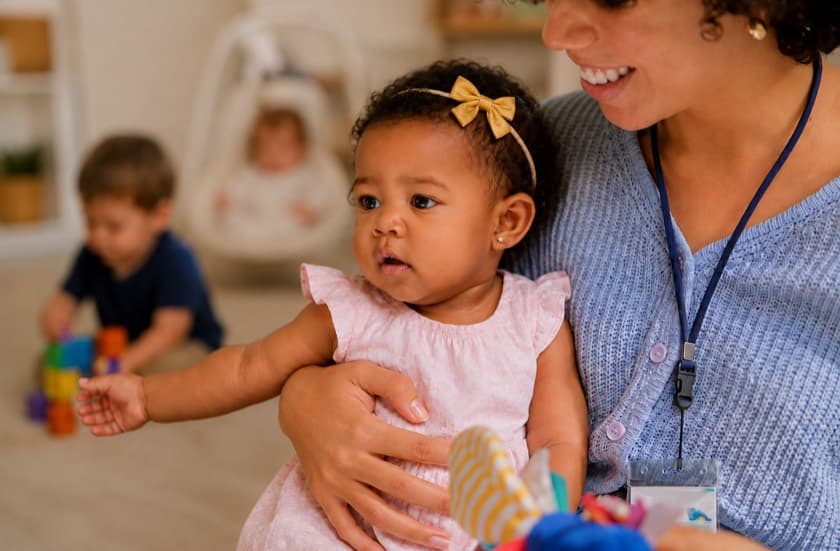
Early Care and Education
See the evidence
Home Visiting
See the evidence
Early Intervention
See the evidence
Child Welfare
See the evidence
Pediatric Primary Care
See the evidence
The full curriculum
We offer ten free, self-paced courses that run from defining the work to evaluating it. Anyone can take them, and you don't need an account.
- Strengthening Early Childhood ProgramsThis tutorial explains why mental health belongs in early childhood settings. It also shows what consultation changes in Head Start.
- Defining Early Childhood Mental Health ConsultationThis tutorial explains what consultation is and what it isn't. It also covers the consultant's role.
- The Effective Mental Health ConsultantThis tutorial covers who does this work and the competencies it takes. It also shows how to deliver high-quality services.
- Mastering the Consultative StanceThe consultative stance is what this work rests on. This tutorial shows how a consultant holds it in practice.
- Partnering with FamiliesThis tutorial treats family engagement as part of consultation practice. It covers how to set the stage for partnerships with families and how to strengthen them.
- Recognizing and Supporting Social Emotional DevelopmentThis tutorial covers social and emotional development from the first year through age five. It also covers risk factors and community referrals.
- Recognizing and Addressing TraumaThis tutorial explains trauma and how it affects young children. It covers the signs to watch for and the consultant's role.
- Developing a Vision and Strategic PlanThis tutorial shows how to turn a mental health vision into a program-level strategic plan and put it into practice.
- Implementing and Evaluating ECMHCThis tutorial covers job descriptions, hiring, contracts, workgroups, and continuous quality improvement.
- Cultural and Linguistic CompetenceThis tutorial looks at the cultural context of consultation and how to practice in a culturally responsive way.
Guides
Each guide gathers everything we've published on one subject into a single page you can read start to finish.
- Classroom ideas that hold big feelingsTeachers can use these classroom ideas right away. They cover emotions, friendship, problem solving, and handling disappointment.
- The IMH specialist suiteWhat infant mental health work is, what an IMH specialist does, and where to find specialized training.
- Five actions on maternal depressionFive actions for programs: identify families, train staff, use reflective supervision, connect families to care, and reduce stigma. Take them in order. The sequence is the intervention.
Help us expand the evidence base
We're growing our resources and research, and we want to work with researchers.
Key topics of focus:
- The impact of IECMHC in Home Visiting, EI, and Child Welfare
- The ROI of IECMHC and impact on staff turnover, expulsion and suspension rates
- The effectiveness of IECMHC consultants from non-clinical backgrounds
Become a Center of Excellence and Attunify certified consultant
Train with the team that wrote the national IECMHC competencies.