
Lesson 1Introduction & Overview
Meet Your Facilitators
The Center of Excellence for Infant & Early Childhood Mental Health Consultation is pleased to partner with the Children's Equity Project to present this learning module on Equity, Disparity, & Bias.
Below you will find information on each of our facilitators. Click on the interactive 'i' icons to read their respective biographies.
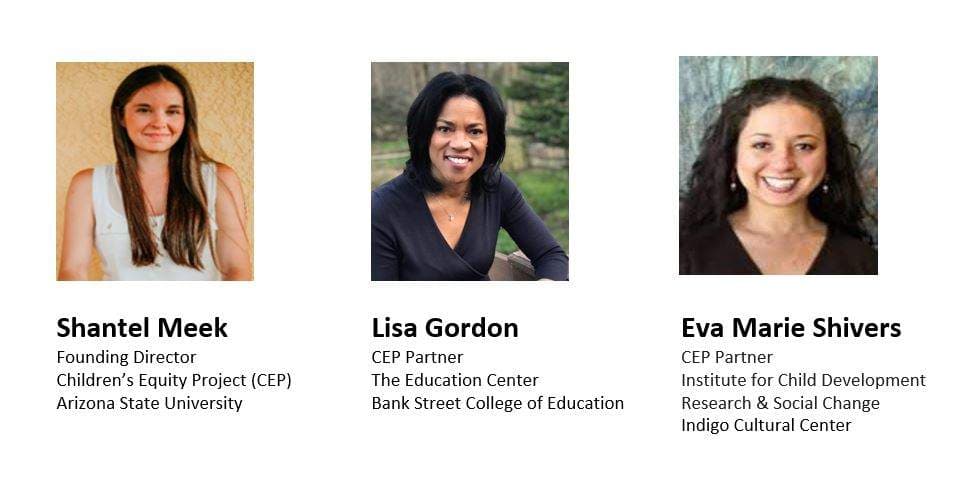
Shantel Meek, PhD
Dr. Shantel Meek is a Professor of Practice and Director for Policy at the Center for Child and Family Success in the T. Denny Sanford School of Social and Family Dynamics at Arizona State University. She is the Founding Director of the Children's Equity Project, a multi-university initiative that aims to close opportunity gaps between children from historically marginalized communities and their peers. Dr. Meek is also a consultant in early childhood research, policy, and strategy at the Bipartisan Policy Center in Washington D.C. Previously, Dr. Meek served in the Obama Administration as a Senior Policy Advisor for Early Childhood Development at the U.S. Department of Health and Human Services (HHS) and as a Senior Policy Advisor for Education in the Domestic Policy Council at the White House. She holds a B.A. in Psychology and an M.S. and Ph.D. in Family and Human Development from Arizona State University.
Eva Marie Shivers
Eva Marie Shivers, J.D., Ph.D. is the executive director of Indigo Cultural Center, a non-profit action research firm located in Phoenix, AZ. Dr. Shivers' work at Indigo Cultural Center focuses on the developmental niche of infant and early childhood development, mental health and education to explore the evolution of frameworks for understanding families' culturally adaptive responses to poverty, systemic racism, and historical marginalization.
Prior to relocating to Arizona, Dr. Shivers was a faculty member in the School of Education at the University of Pittsburgh. She received her Ph.D. from UCLA's Department of Education, Psychological Studies in Education. Dr. Shivers also holds a law degree from Howard University School of Law, and a BA in English Literature from Arizona State University.
Dr. Shivers has numerous peer-reviewed publications, and presents her research on equity, child care, mental health consultation, and other early childhood professional development initiatives throughout the country. She has served as Principal Investigator on many child care studies that involve collaborating with community agencies, national organizations, as well as state and county administrations. Racial equity is central to all research, evaluation and training efforts.
She currently provides early childhood racial equity training and consultation to infant and early childhood mental health community agencies and state departments around the country. For the past fifteen years, Dr. Shivers has provided child care research policy consultation to federal, state and local government agencies and administrators.
Lisa Gordon
Lisa Gordon is Associate Director of Early Childhood Programs for the Center on Culture, Race & Equity (CCRE) at Bank Street College of Education. She partners with communities across the US to strengthen their capacity to create equitable learning environments that are responsive to the needs of children and families. Central to her work is her focus on elevating issues of culture, race and implicit bias that have created opportunity gaps for children and families in disenfranchised communities and children and families of color, in order to effect systemic change to program policies and practices. Lisa has worked in early childhood education for the past 20 years designing and delivering professional development, training, technical assistance, and programs at both the state and federal levels that facilitate the well-being of children and families. She is co-founder of Colorful World, a women-owned diversity education consulting firm whose mission is to help early childhood educators create inclusive educational learning environments that empower all children and families to succeed.
Prior to her work with CCRE, Lisa was an Early Childhood Development Trainer with the Office of Head Start National Center on Culture and Linguistic Responsiveness where she co-developed research to practice materials for dissemination and facilitated trainings across the country. She has served as Director of the Child Care Resource and Referral Agency and the Professional Development Registry for the District of Columbia Office of the State Superintendent of Education, and on several national school readiness and research initiatives with National Black Child Development Institute (NBCDI) and the Center on Health and Education at Georgetown University. Lisa has been a mentor and coach to elementary school principals to help strengthen their capacity to lead high quality early childhood programming and to improve the quality and coherence of student learning across PreK to Grade 3. Her areas of expertise include creating high quality culturally responsive learning environments, supporting social emotional development and school readiness, building early childhood leadership capacity, and teacher effectiveness and professional development.
The Children's Equity Project is a multi-university initiative, housed at Arizona State University, that focuses on closing opportunity gaps and ensuring that all children, regardless of race, ethnicity, language of origin, and ability, reach their full potential. Learn more (opens in a new tab)
Module Objectives:
- Increase awareness of issues of equity in early care and education settings, including racial bias and disparities.
- Examine how personal and professional values and beliefs impact relationships with children, families, and practitioners.
- Identify ways to address equity, bias, and disparities in early care and education settings within a consultation framework.
Getting Started: An Introduction to Addressing Equity, Disparity, & Bias
If we are to be intentional about disrupting racial bias, it begins with us naming it, building our awareness, and doing everything we can to achieve equity, starting with ourselves and every level of our work.